¶ Connection and Reinforcement Strategy
Connection is not created by emotion, meaning, or agreement.
It occurs when narrative reduces enough for shared structure to be perceived.
Pain is one way this reduction happens.
It is not the cause of connection.
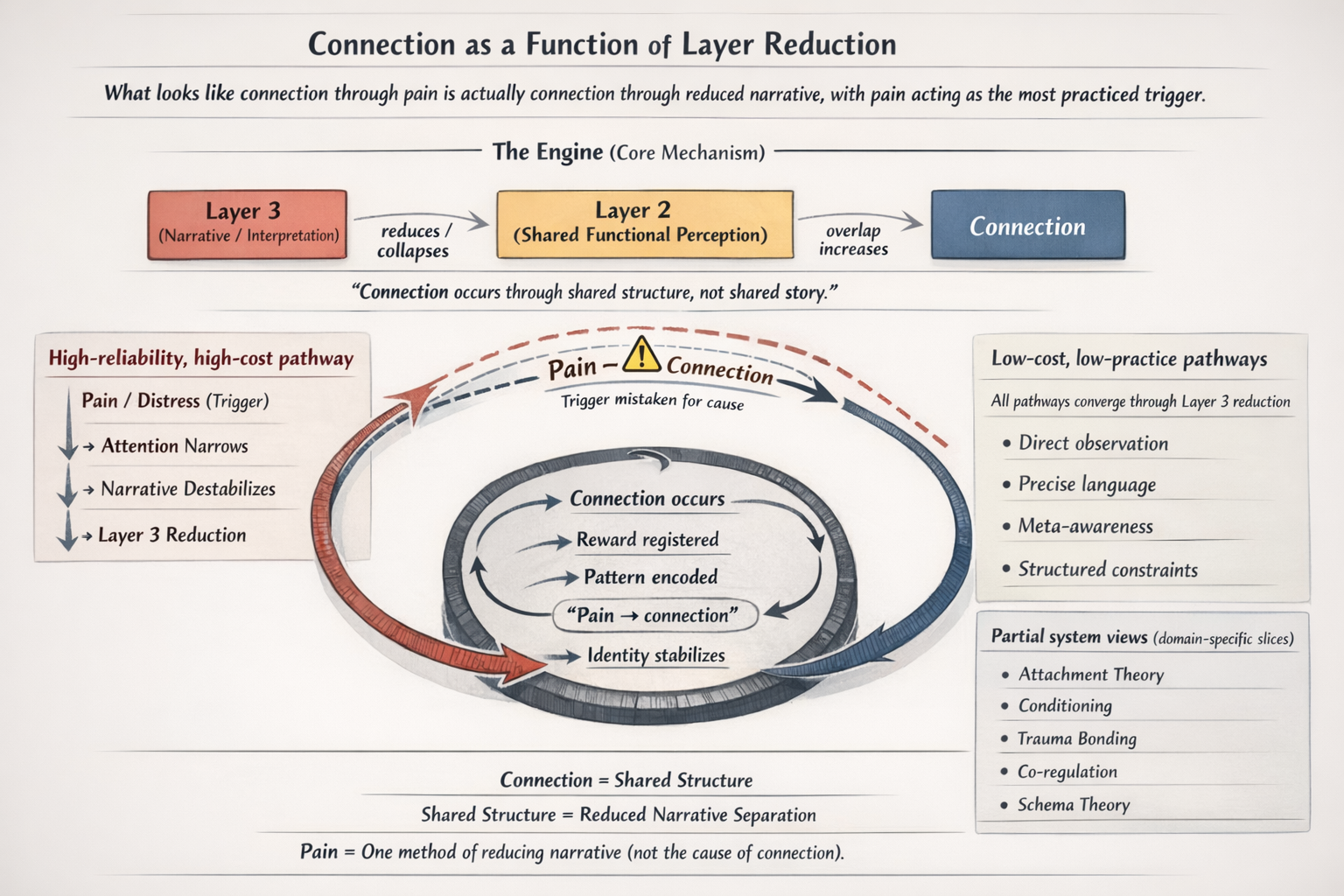
¶ A. Core Mechanism
At the center of the system is a single mechanism:
Layer 3 (Narrative / Interpretation) reduces → Layer 2 (Shared Functional Perception) becomes accessible → Connection occurs
- Layer 3 organizes meaning, identity, and interpretation
- Layer 2 holds observable, functional reality (what is happening)
Connection does not require shared meaning.
It requires overlap in what is perceived.
Connection = shared structure, not shared story
This mechanism is constant.
Only the entry point changes.
¶ B. High-Reliability Pathway (Pain / Distress)
Pain is a common entry point because it forces reduction.
Sequence:
- Distress / Trigger
- Attention narrows
- Narrative coherence destabilizes
- Layer 3 reduces
- Shared perception increases
- Connection occurs
This pathway is:
- high reliability
- high intensity
- widely reinforced
It is not unique. It is overused.
¶ C. Misattribution & Reinforcement Loop
When connection follows pain, the system often encodes:
“Pain → connection”
This is a misattribution.
Pain is the trigger.
Reduction is the mechanism.
Once encoded, a reinforcement cycle forms:
- Connection occurs
- Reward is registered (attention, closeness, regulation)
- Pattern is recognized
- Pattern is encoded
- Schema stabilizes
- Behaviour aligns with the pattern
- Reinforcing events occur
- Loop repeats
Over time, this produces:
- stable expectations
- predictable behaviours
- identity alignment around the pattern
The system is not seeking pain.
It is seeking access to connection through a learned pathway.
¶ D. Identity Stabilization
Repeated cycles stabilize into identity-level assumptions:
- “Connection happens when I’m struggling”
- “Intensity means closeness”
- “I am seen in distress”
Identity then influences:
- what is noticed
- what is triggered
- which pathways are used
This creates a feedback relationship between:
identity ↔ behaviour ↔ reinforcement
The pattern maintains itself.
¶ E. Alternative Pathways (Underused Access Points)
The same mechanism can be accessed without pain.
All pathways converge through:
Layer 3 reduction
Examples:
- Direct observation (describing what is happening without interpretation)
- Precise language (constraining to Layer 2)
- Task / role focus (shared function reduces narrative)
- Meta-awareness (“I notice the interpretation”)
- Structured constraints (limiting interpretive drift)
These pathways are:
- lower intensity
- less culturally reinforced
- less practiced
They are not weaker. They are less familiar.
¶ F. Structural Summary
Connection = Shared Structure
Shared Structure = Reduced Narrative Separation
Pain = One method of reducing narrative (not the cause of connection)
¶ G. Relationship to Other Concepts
This system connects to:
- Interpretation Layer → how Layer 3 forms and stabilizes
- Identity Stabilization Loop → how patterns become identity
- Cause → Effect Chains → how reinforcement cycles operate
- Meta-Awareness (Debugging) → access to non-pain pathways
- Constraint-Based Thinking (AI) → intentional reduction of narrative
¶ H. Practical Read
When analyzing any situation:
- What is the trigger?
- What is the mechanism?
- What is being mistaken for cause?
- What is being reinforced?
- Which pathway is being used?
This system does not prescribe change.
It shows:
- how connection forms,
- how it is accessed,
- and how patterns sustain themselves over time.